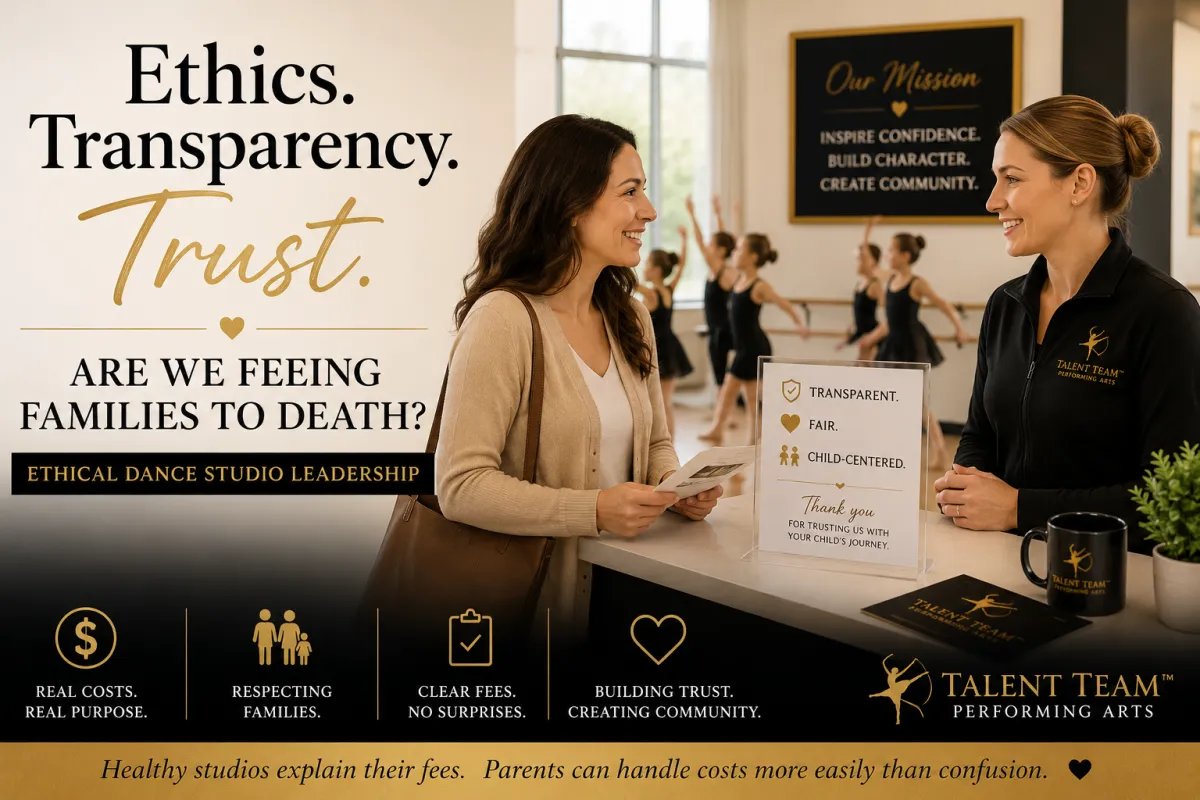
Are We Feeing Families to Death? Ethics, Transparency, and Trust in Dance Studios
Are We Feeing Families to Death? Ethics, Transparency, and Trust in Dance Studios
Let’s talk honestly about something many families feel — but don’t always know how to say:
dance can become expensive.
Very expensive.
For many parents, what begins as one class a week can slowly become a long list of unexpected costs:
Registration fees.
Recital fees.
Costume fees.
Competition fees.
Convention fees.
Photo fees.
Mandatory extras.
Studio merchandise.
Special rehearsals.
Tickets.
Fundraisers.
And before long, families may quietly find themselves asking:
“Wait… where is all of this money actually going?”
That can create frustration, confusion, and sometimes even resentment.
But this conversation deserves honesty from both sides.
Because here is the truth:
Running a Healthy Studio Costs Real Money
Dance studios are not inexpensive to operate.
There is rent.
Insurance.
Utilities.
Music licensing.
Teacher pay.
Administrative systems.
Recital venues.
Costumes.
Staffing.
Technology.
Equipment.
Cleaning.
And countless behind-the-scenes expenses most families never see.
Many studio owners are not becoming wealthy.
They are working incredibly hard to serve children while trying to keep their doors open.
So the answer is not:
“Studios should never charge fees.”
That would not be realistic.
The better question is:
Are fees ethical, transparent, and truly necessary?
That is where trust begins.
The Difference Between Necessary Fees and “Fee Fatigue”
Parents can often handle costs more easily than confusion.
What creates frustration is not always the amount.
It is the surprise.
Or the feeling that charges appear without explanation.
Or the fear that every new opportunity somehow comes with another required payment.
Families today are stretched.
And when studios unintentionally create “fee fatigue,” trust can quietly erode.
Even wonderful programs can lose goodwill when communication becomes unclear.
The healthiest studios understand this:
Transparency matters.
Ethical Studios Explain Their Fees
A fee should never feel random.
Families deserve to understand:
Why does this fee exist?
For example:
Registration Fees
A registration fee should not exist simply because:
“Every studio has one.”
Instead, it should serve a real purpose.
It may help cover:
enrollment systems
student administration
onboarding materials
software
insurance
account setup
Parents are far more understanding when they know what a fee actually supports.
Recital Fees
A recital fee often makes sense.
Productions cost money.
Theater rental.
Lighting.
Sound technicians.
Backstage staffing.
Insurance.
Programs.
Production support.
Some studios also include complimentary tickets within that fee, helping families feel greater value and clarity.
Again:
clarity builds trust.
Costume Fees
Families appreciate honesty.
Tell them:
what the costume costs
what is included
whether tights or accessories are separate
deadlines
refund policies
Surprises create stress.
Clear expectations create peace.
Trophies Should Never Matter More Than Families
This part may feel uncomfortable to say, but it matters.
In some areas of the performing arts world, competition culture can quietly shift priorities.
More competitions.
More conventions.
More entry fees.
More spending.
More pressure.
Sometimes it can begin to feel like children are carrying financial expectations they never asked for.
Of course, competition itself is not the problem.
Healthy competition can build:
resilience
discipline
confidence
teamwork
But studios must ask themselves an important question:
Are we serving families — or exhausting them?
Because there is a difference.
Children do not need constant pressure, endless fees, or expensive extras to thrive.
Sometimes they simply need:
good teaching
encouragement
healthy challenge
meaningful opportunities to grow
Ethical Leadership Builds Long-Term Trust
Families remember how a studio made them feel.
Did they feel:
respected?
pressured?
supported?
confused?
valued?
Healthy studios communicate openly.
They explain costs clearly.
They avoid unnecessary surprises.
And they remember something important:
Families are not simply customers.
They are trusting us with their children.
That trust deserves care.
Because in the end:
Parents can handle costs more easily than confusion.
And the strongest studios are not always the ones charging the most.
Often, they are the ones building the deepest trust.