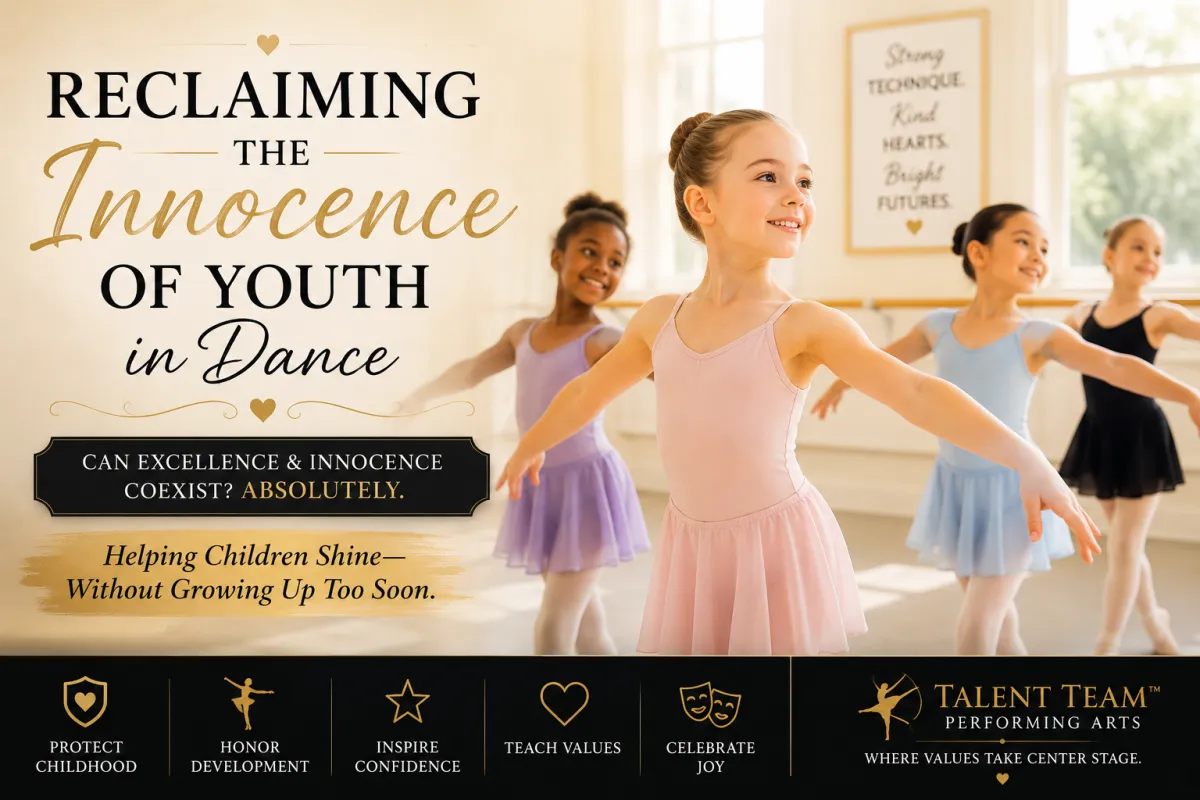
Reclaiming the Innocence of Youth in Dance
Reclaiming the Innocence of Youth in Dance
Childhood is astonishingly short.
One moment children are twirling barefoot in the living room, pretending to be ballerinas or Broadway stars.
And before we know it, they are growing up.
That reality alone should make us pause.
Because in the performing arts world, children are often asked to grow up very quickly.
Sometimes too quickly.
Let’s have an honest conversation about something many parents and teachers quietly wrestle with:
What happens when childhood begins to disappear too soon?
Confidence and Childhood Are Not Opposites
Every parent wants confident children.
Every teacher wants students who shine.
Every studio wants children to feel capable, expressive, and strong.
Those are beautiful goals.
But somewhere along the way, parts of the performing arts world began sending an unfortunate message:
To be talented, children must become older faster.
Older music.
Older choreography.
Older costumes.
Older emotional themes.
Older attitudes.
And often, children are asked to portray emotions or ideas they are not yet old enough to fully understand.
But confidence and maturity are not the same thing.
And confidence does not require sacrificing innocence.
Children can absolutely be:
talented
expressive
powerful performers
technically strong
stage-ready
while still remaining wonderfully age-appropriate.
Those things are not opposites.
Children Internalize What Adults Normalize
Research in child development consistently suggests something important:
Children absorb the messages around them.
How adults speak.
What adults celebrate.
What adults normalize.
The music they repeat.
The images they imitate.
The expectations they begin to believe about themselves.
Studies have linked premature exposure to overly mature themes and sexualized environments with increased risks of:
body image concerns
anxiety
depression
lower self-esteem
confusion around identity and boundaries
This does not mean children should live in a bubble.
Nor does it mean every disagreement over costumes or choreography is harmful.
But it does invite an important question:
Are we helping children grow — or quietly rushing childhood away?
That question matters.
The Mixed Message Families Sometimes Feel
Many parents know this tension well.
At home, they teach one set of values.
At church, another message may be reinforced.
But then a recital, performance, or competition arrives and suddenly they feel conflicted.
They wonder:
“Why does this suddenly feel older than my child?”
Or:
“This doesn’t quite align with the values we are trying to teach.”
Sometimes families stay silent because they do not want to seem difficult.
But their discomfort is real.
And healthy studios should make room for those concerns.
Because trust matters.
Excellence Does Not Require Shock Value
Somewhere in the arts world, there can be pressure to stand out.
Bigger tricks.
Edgier music.
More dramatic themes.
Costumes designed to feel older.
Competitive pressure.
But here is something beautiful many experienced educators eventually discover:
Children do not need adult themes to shine.
Joy shines.
Technique shines.
Storytelling shines.
Kindness shines.
Playfulness shines.
Confidence shines.
Authentic childhood shines.
And audiences often feel the difference.
There is something deeply refreshing about seeing children allowed to simply be children.
Protecting Innocence Does Not Mean Lowering Standards
This matters.
Protecting childhood is not about lowering expectations.
It is not about weak technique.
It is not about avoiding excellence.
In fact, many of the strongest programs are also deeply values-centered.
Children can learn:
discipline
focus
artistry
performance quality
confidence
resilience
while still remaining age-appropriate in music, movement, costuming, and themes.
Excellence and innocence can coexist beautifully.
Reclaiming What Matters Most
Perhaps the question is not:
“How quickly can children look grown up?”
But rather:
“How beautifully can we help them grow?”
Because childhood does not come back.
And one day, long after the costumes are packed away and recital flowers are forgotten, what children will remember most is how they felt.
Did they feel:
safe?
celebrated?
respected?
encouraged?
free to grow at a healthy pace?
The arts should never rush childhood away.
At their best, they protect it.
And perhaps that is one of the greatest gifts we can give the next generation:
A chance to shine brightly — without growing up too soon.