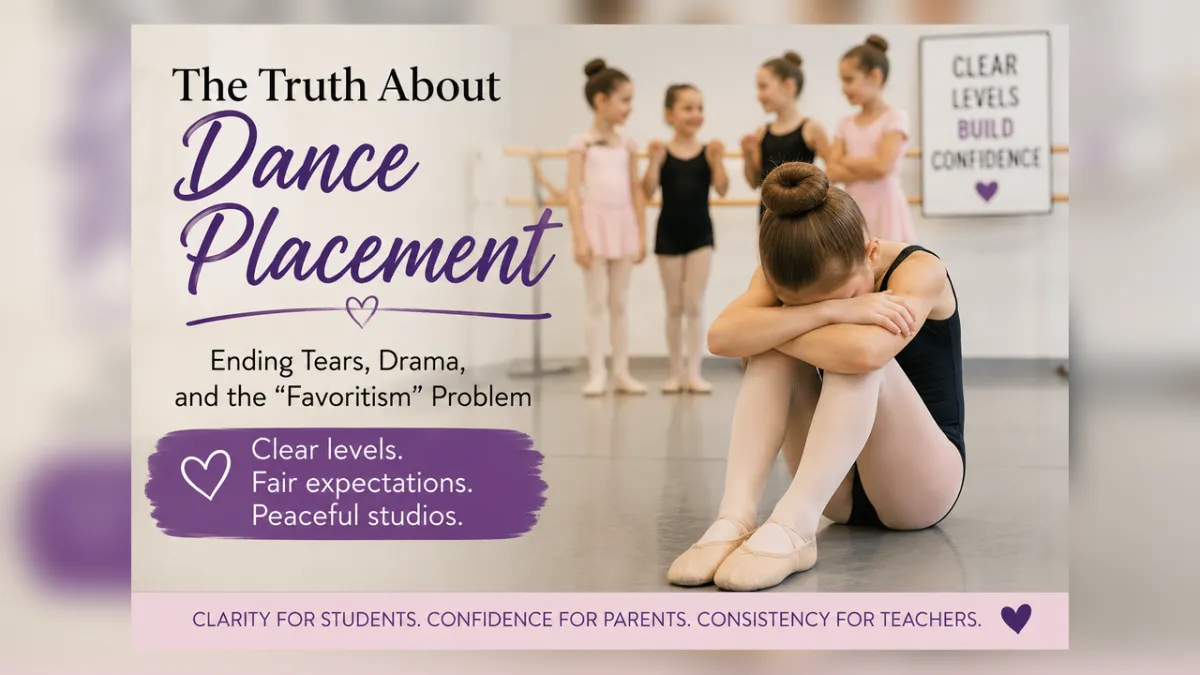
The Truth About Dance Placement: Ending Tears, Drama, and the “Favoritism” Problem
If you’ve been in dance education long enough, you’ve probably seen it.
The tears.
The confusion.
The quiet car ride home after placement evaluations.
A parent trying to comfort a discouraged child who finally whispers:
“Why did she move up and I didn’t?”
Or maybe you’ve overheard the hallway conversations — the ones spoken just softly enough to sound harmless, but heavy enough to sting:
“I think the teacher just likes certain kids.”
Let’s just say it plainly:
placement drama is real.
And right alongside it sits something even trickier to navigate — the difference between perceived favoritism and actual favoritism.
Because here’s the truth most studio owners already know deep down:
Even when favoritism isn’t happening, if families think it is, the impact can feel almost the same.
The Reality Most Studios Are Living In
Most teachers genuinely care about their dancers. They’re not trying to hurt feelings. They’re not intentionally choosing favorites. They’re doing their best with the systems they inherited — systems that often weren’t built to handle the emotional weight of placement season.
But here’s where things get complicated:
When advancement decisions feel unclear or inconsistent, families start filling in the blanks themselves.
If one child moves up and another doesn’t — and no one understands why — emotions rise quickly.
Students compare themselves.
Parents speculate.
Teachers feel misunderstood or defensive.
And suddenly, what should be an exciting season of growth becomes a season of stress.
Not because anyone is trying to create drama.
But because expectations weren’t clear.
Perceived Favoritism Hurts Almost as Much as the Real Thing
This part is hard to talk about, but it matters.
Sometimes favoritism does happen.
But far more often, what families are reacting to is something else entirely:
a lack of transparency.
When students don’t know what’s expected of them, they start comparing themselves to others. They notice:
Who moved up.
Who got featured.
Who gets more attention.
Who seems to advance faster.
And without visible standards, kids start drawing painful conclusions:
“Maybe I’m not good enough.”
Or worse:
“Maybe the teacher likes them better.”
Parents feel that pain too.
Teachers feel misunderstood.
Trust quietly begins to erode.
Even wonderful studios with caring teachers and good intentions can struggle with this. Because good intentions alone can’t carry the emotional load of unclear systems.
The Emotional Cost of Unclear Placement
For children, dance is deeply personal.
It is not simply an activity.
It becomes tied to confidence, friendships, identity, courage, and belonging.
When advancement feels mysterious or inconsistent, students may begin to experience:
discouragement
unnecessary comparison
anxiety around placement time
resentment toward peers
fear of failure
loss of confidence
And parents?
Parents are left trying to explain decisions they do not fully understand themselves.
That can create tension between families and studio leadership — even when no harm was intended.
The truth is this:
clarity protects relationships.
So, What Is the Solution?
The healthiest studios do not remove emotion entirely.
But they do remove unnecessary confusion.
The answer is clear benchmarks.
When students understand:
“Here is what I am working toward.”
everything changes.
Instead of wondering:
“Why didn’t I move up?”
they can ask:
“What skills do I still need to master?”
That is a very different conversation.
Healthy leveling systems create:
Clarity for Students
Children understand expectations.
Confidence for Parents
Families can see progress objectively.
Consistency for Teachers
Placement decisions become grounded in standards rather than opinion.
Peace for Studios
Less drama.
Less confusion.
Less hallway speculation.
Simply put:
clear levels create peaceful studios.
Growth Is Not Failure
One of the most important lessons we can teach children is this:
Not moving up yet does not mean failure.
Growth happens at different speeds.
Some children gain flexibility quickly.
Others mature musically.
Some develop confidence later.
Some become extraordinary because they stayed committed when things felt hard.
A healthy dance education teaches children: Progress matters more than comparison.
That lesson serves them long after recital season ends.
The Goal Is Not Perfection — It Is Trust
Parents do not expect perfection.
Students do not expect perfection.
But they do need trust.
And trust grows when expectations are visible, advancement is understandable, and students feel supported in the process.
The best studios are not necessarily the ones with the flashiest tricks or biggest trophies.
They are the ones where students feel seen, families feel respected, and growth feels fair.
Because at the end of the day:
Children cry less when expectations are clear.
Parents worry less when standards are visible.
Teachers teach better when advancement is objective.
And maybe — just maybe —
we can keep the drama on the stage…
and out of the lobby.